
Two Fairfield Porter Paintings
"Katie," 1969 and "Jimmy and John," 1957-58 might be the standouts in "What Everyone Knows"

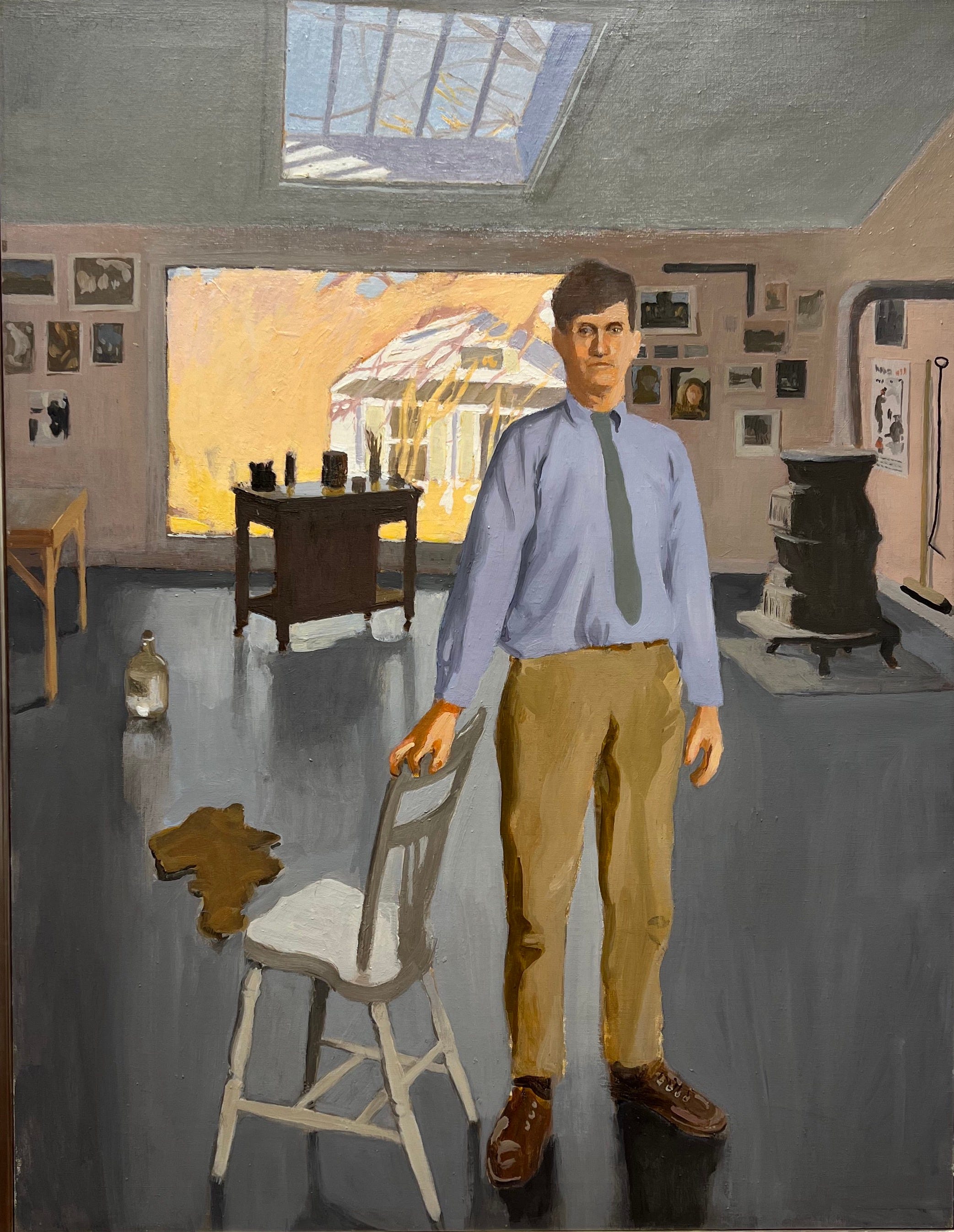
I feel fortunate to have seen Fairfield Porter: What Everyone Knows at the Art Students League in New York City twice last week. This is the first large-scale exhibition of Porter’s work in New York in twenty-five years. More than thirty-five paintings are included, many on loan from the Parrish Art Museum in Southampton, which received approximately 250 works from the Porter estate.
Saul Ostrow, writing in The Brooklyn Rail, quickly gets to the heart of Porter’s practice:
“What appear to be different pictorial problems—a still life, a portrait, a landscape, an interior—are variations on the same underlying question: whether paint can simultaneously sustain its abstract conditions and its descriptive obligations.”
That observation serves as an excellent point of entry into the exhibition. Porter’s paintings may depict family members, friends, interiors, landscapes, and gardens, but the underlying concerns remain remarkably consistent. The subject changes; the central question does not.
Exhibition curator, Sam Sackeroff, reinforces this point in both his wall texts and catalog essay while drawing attention to Porter’s parallel concerns with mid-twentieth-century American poetry, particularly questions of specificity and realism. Sackeroff centers his argument on Porter’s conviction that “the real is specific” and on his belief that art deals in appearances rather than systems or ideas. Again and again, Porter returned to the particular and the concrete as the essential subjects of art.
The poet James Schuyler appears in several of the paintings on view. As Anne Porter famously remarked, “Jimmy came for the weekend and stayed for eleven years.” Knowing something about Schuyler’s poetry enriches the experience of looking at Porter’s paintings. Schuyler’s poems are not realistic because they accurately describe objects. They are realistic because they preserve the instability of experience itself. Weather, flowers, a room, a passing conversation, a fleeting sensation—Schuyler records these without forcing them into a symbolic framework or grand narrative.
Porter pursued a similar ambition in paint. His realism is far from being primarily descriptive. Rather, it emerges from a desire to hold together the abstract realities of painting and the familiar realities of lived experience. It feels like he wanted paint to remain paint while still capturing the sensations of perception and recognition. The way I see it, painting from life for Porter was just as much about contradictions and ambiguity as about craft, certainty and appearance. He struggles with modeling but doesn’t cover that up. Some of his figures and faces separate from their surroundings and Ostrow identifies this as “unfinished” in his essay. Perhaps this is Porter resisting the suppression of the familiar. He’s consistently acknowledging the act of painting.
Sackeroff’s emphasis on Porter’s essays—What Is Real, The Immediacy of Experience, Against Idealism, and Art and Knowledge—is particularly valuable because those texts repeatedly argue that painting possesses a kind of knowledge unavailable to philosophy or science. Painting deals with appearances, with the fleeting particulars of lived experience, and Porter believed those appearances contained truths that could not be reached through theory alone.
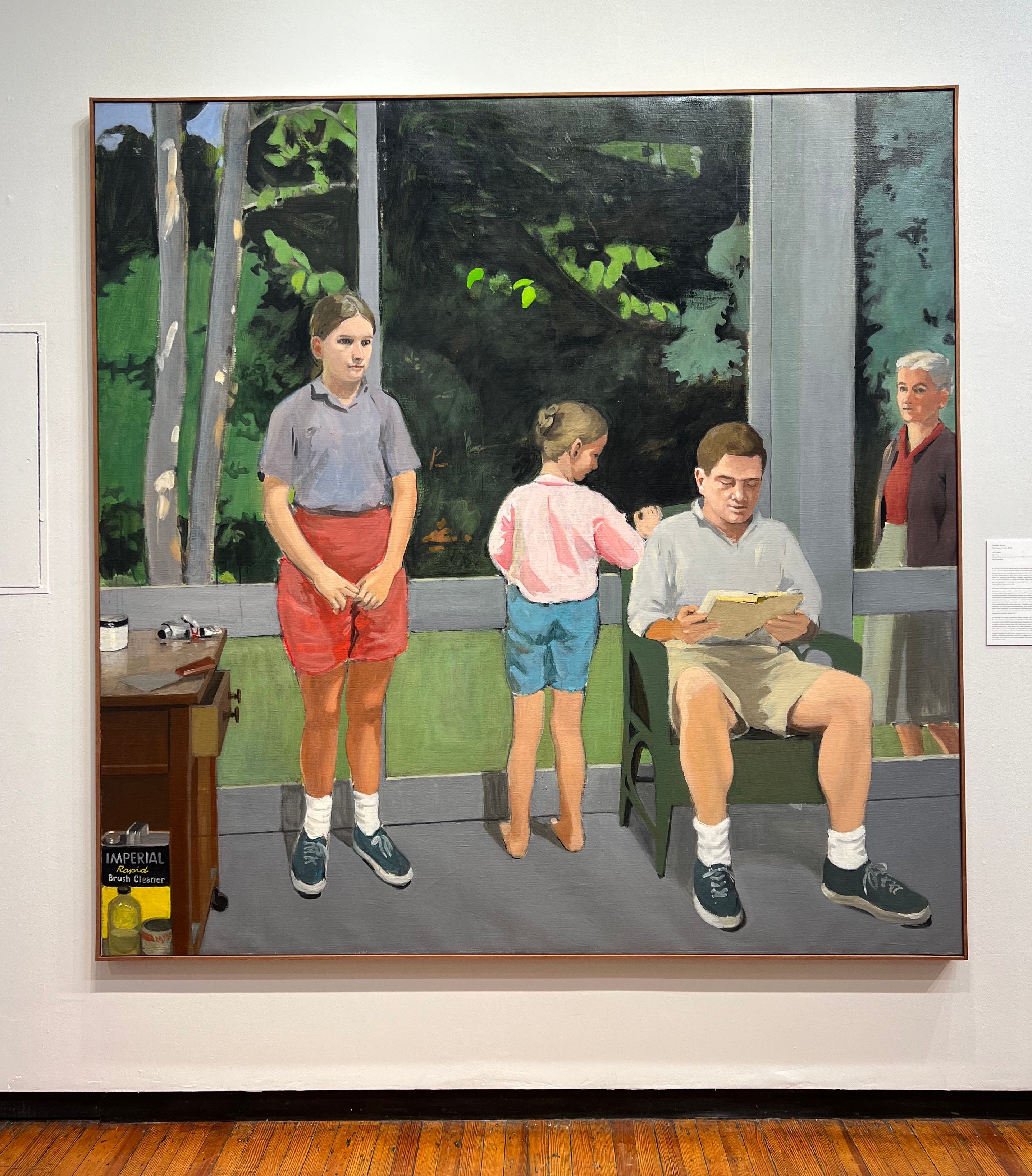
The layout of the Art Students League galleries naturally draws visitors toward major works such as The Screen Porch (1964) and Self-Portrait (1968). Yet after two visits to the exhibition, and after spending time drawing from Katie (1969) and Jimmy and John (1960), I found myself most captivated by these two intimate paintings.
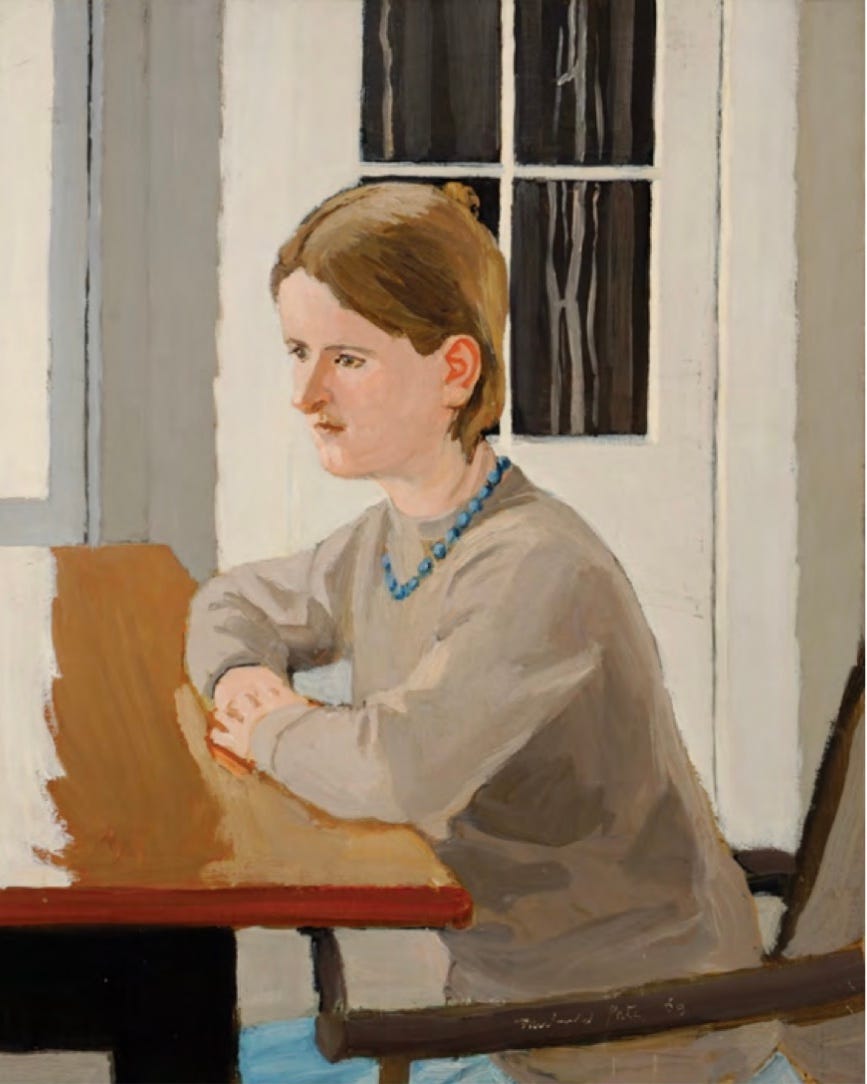
In Katie (1969), a passage on the left side of the composition demonstrates Porter’s extraordinary ability to merge observation with abstraction. The desktop catches strong light, described by a brilliant swatch of white set against the brown of the wooden surface. Anyone who has observed sunlight striking a sealed wooden tabletop might recognize the phenomenon immediately: the highlight approaches pure white while the local color remains intact. Porter captures this visual event without modeling it, allowing it to function as a distilled arrangement of shapes and colors. The passage is both observed fact and abstract construction. It is reminiscent of a Milton Avery wave.
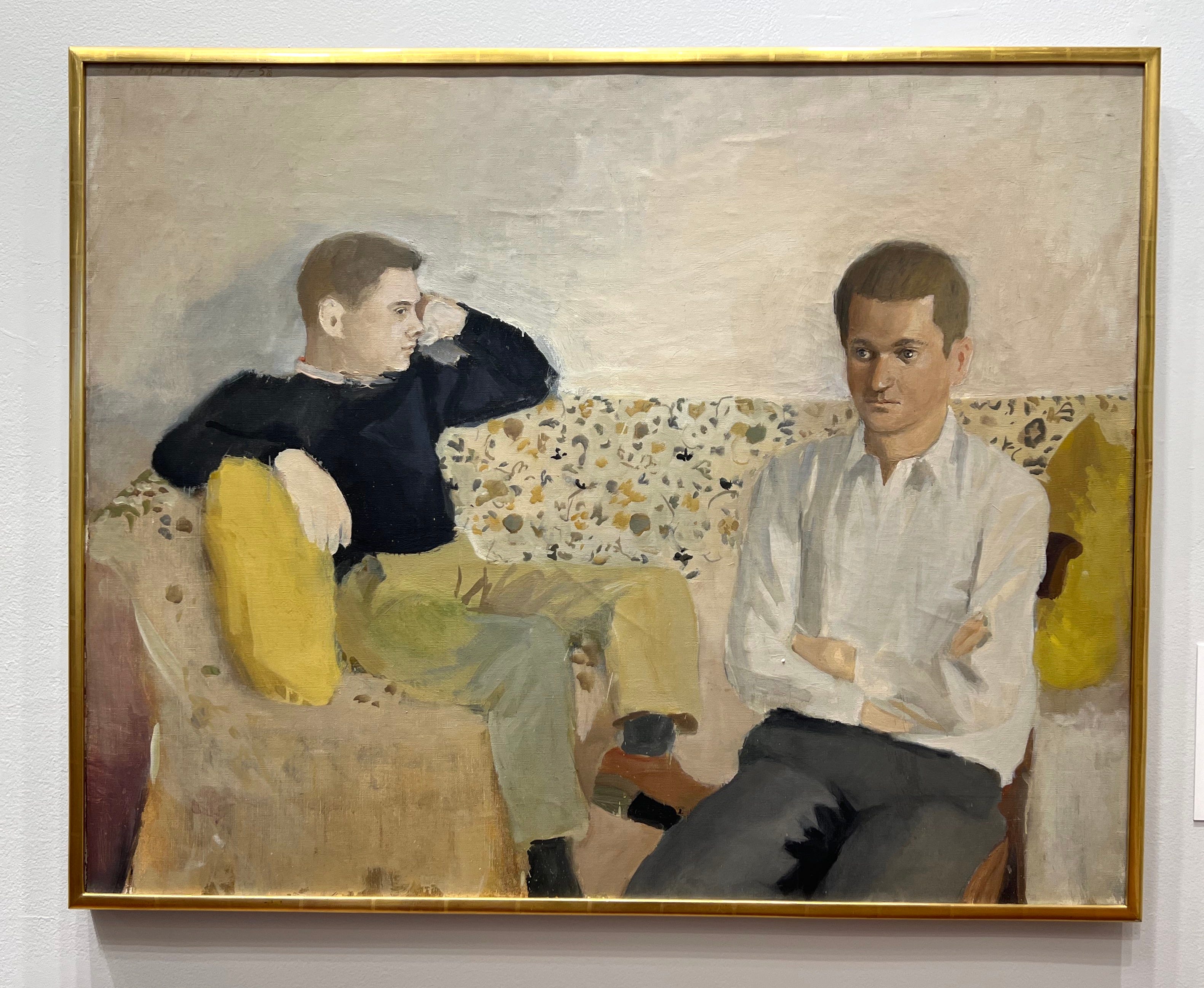
Jimmy and John (1957-58) reveals a different aspect of Porter’s achievement. The painting quietly acknowledges the influence of Vuillard, one of Porter’s most admired artists. At first glance the two poets may appear stiff, and their faces somewhat awkwardly modeled. Yet sustained looking produces a different experience. The eyes of both figures gradually rise to the surface of the picture plane joining Jimmy’s right hand and the end of the pillow. What initially seems awkward begins to feel intensely satisfying and specific. Porter’s struggle to capture likeness coexists with the emotional force of a personal narrative. As Sackeroff so deftly points out, Porter’s figures are generally all gazing, actively observing, reminding us again of the seeing theme. The strong black shapes in the bottom of the painting ground Jimmy but also circulate us through the composition. The black shapes reference the integrity of the painting’s two dimensionality - its fiction. Black frequently plays this roll in Porter’s work and succeeds because just like his whites, it exists not merely as a value but as a color. (Note the black broom and the stove tool on the far right in Self Portrait (1968). The stove in Self Portrait is not as black as it appears in reproduction. It sits in the back of the painting because it is carefully muted, understated.)
Perhaps this is the enduring experience of Porter’s work. An initial awkwardness—sometimes even a resistance—is gradually replaced by a rewarding reminder that paintings are built. Paintings, like our take on the world, are personal compilations of what is noticed, what is retained and what is abandoned. Painting, like looking, is a conversation between observation and invention, art historical knowledge and direct experience, between the painter’s intentions and the paintings own voice.
Few painters have been more committed to the belief that the universal can be reached through the particular. Fairfield Porter: What Everyone Knows reminds us that Porter’s achievement lies not simply in depicting the world around him, but in showing how perception, and attention itself can be the subject of painting.
The Porter exhibit is on view June 5-August 18, 2026 with a number of talks taking place throughout the show. Check the League website for details.
Art Students League Gallery Hours
Monday – Friday: 10 am – 7 pm
Saturday: 10 am – 4 pm
If you’re in New York City in July, don’t miss the Izzy Barber exhibition, Clay Pigeons, at Charles Moffett gallery in lower Manhattan through July 31, 2026.
So insanely useful bit of writing on this. Thank you
Really appreciate your review and perspective. Thank you.